Loading
Loading
Mining · Minerals Processing · Heavy Industry
Abrasion, impact and corrosion are the fastest way to wear out unlined steel plant. Slurry pipes, tanks, chutes and screen decks all erode in service, driving repeat replacement cost and unplanned downtime. AU Industries supplies industrial linings and wear lining solutions that move that wear into a replaceable lining instead of the equipment itself, extending service life across mining, minerals processing and heavy industry in South Africa.
We line in-house and on site, matching the lining to the wear mechanism: resilient rubber for slurry abrasion, harder and premium compounds for impact and cutting duty, chemical-resistant compounds for acid and hydrocarbon service, and ceramic-embedded panels for the most severe transfer-point and chute service. Every surface is prepared to SA 3 standard before lining, the single biggest factor in long-term adhesion.
The general-purpose industrial lining for slurry and process plant. Natural rubber lining in 40 Shore absorbs fine-particle abrasion in pipes, cyclones, pumps and tanks; 60 Shore resists the cutting and gouging of coarse material in chutes and hoppers. Applied as bonded sheet and vulcanised in our autoclave or cured on site.
Where standard rubber is being replaced too often, our in-house AU Premium 38 and 60 Shore Pink compounds extend the interval between relines in the highest-wear zones, at a higher price per square metre but a lower cost per tonne handled.
For sliding abrasion and high-impact zones that cut through rubber alone, such as transfer points, chute liners and crusher discharge, alumina ceramic tiles embedded in a rubber matrix combine the hardness of ceramic with the impact absorption of rubber. See our ceramic-embedded wear panel work.
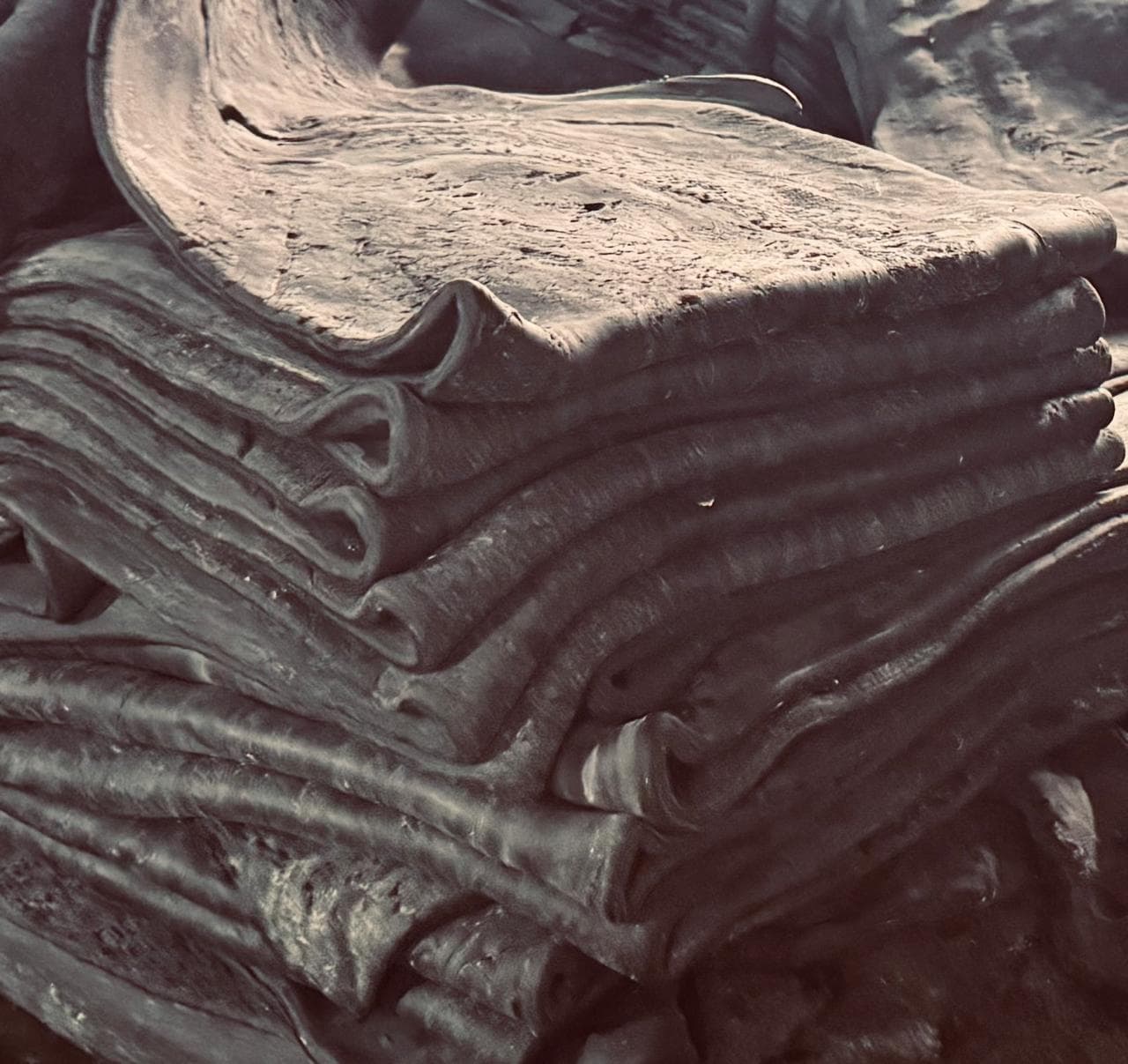
Bromobutyl for acid plants, CIL and CIP tanks and water-treatment vessels; nitrile where oils, fuels and hydrocarbons would swell natural rubber; neoprene for weathering and moderate chemical exposure. All milled as rubber sheeting in Boksburg.
Rubber lined pipework, bends, spools and fittings fabricated and lined in our workshop, with thickness stepped up at bends and reducers where the flow changes direction and wear concentrates.
Most lining failures are adhesion failures, not wear failures. A lining that lifts at an edge or blisters under the surface is nearly always the result of poor surface preparation, contaminated bonding or a cure that was not completed. Our process closes each of those gaps: grit blasting to SA 3 standard, bonded application by experienced lining technicians, controlled autoclave or on-site cure, and spark testing of every lined surface before it goes back into service. Where the wear profile is uneven we increase lining thickness locally at impact and turbulence points rather than over-lining the whole component.
Gold, platinum, coal, copper, uranium and titanium mining and minerals processing, chemical plants, water and wastewater treatment and general heavy industry, from our Boksburg facility across South Africa and on site in Mozambique, Namibia, Zambia, Botswana and Zimbabwe. See our wear lining projects for recent work.
8 Paul Smit Road, ALAC Industrial Park (Cnr Main Street), Anderbolt, Boksburg, 1458, Gauteng, South Africa Tell us what's wearing out — call +27 72 039 8429 or email info@auind.co.za.